
Many people still think an eye test is mainly about whether they need stronger glasses. In reality an NHS eye examination is one of the most accessible preventive health checks in the UK. NHS England says optometry practices provide more than 13 million NHS sight tests a year in England and those appointments help detect early signs of eye disease as well as changes in prescription. That matters because more than 2 million people in the UK live with sight loss, while England recorded over 9.8 million vision outpatient attendances in the financial year ending 2024 a 27% increase since 2014. In other words, eye care is no longer a small niche service; it is a major front door into the wider health system.
There is one important detail to clear up early: the phrase NHS eye examination is used loosely across the UK but the rules are not identical in every nation. In England the routine community appointment is usually called an NHS sight test, and free funding depends on eligibility. In Scotland, all NHS eye tests are free for people living in the UK, refugees and asylum seekers. In Wales, free NHS eye examinations are available through WGOS pathways with their own eligibility criteria. This article focuses mainly on what patients in England can expect, because that is where the nhs.uk sight-test and voucher rules apply most directly.
An NHS eye examination is about more than reading letters off a chart
The clinical purpose of a sight test is broader than many patients realise. The College of Optometrists says that when conducting a sight test, the optometrist must perform an internal and external examination and carry out any additional checks needed to detect signs of injury, disease or abnormality in the eye or elsewhere. That is why a routine appointment can uncover problems that have nothing to do with buying new frames.
This also explains why two patients can have very different experiences in what looks like the same appointment. A healthy 24-year old with mild blur at distance may need a straightforward refraction and eye-health check. A 62-year old with diabetes, a family history of glaucoma, and trouble driving at night may need a more risk focused assessment. The NHS-funded appointment is meant to be clinically appropriate not one-size fits-all.
Just as importantly, an NHS-funded sight test is not supposed to be a sales trap. The College states that the sale and supply of spectacles or contact lenses must not be a condition for performing a sight test, and that practitioners must not charge for procedures undertaken as part of an NHS-funded General Ophthalmic Services sight test. That is useful for patients who worry they will be pressured into upgrades before the actual clinical work is complete.
Before your appointment: how to prepare so the test is actually useful
The best eye examinations are not passive. The optometrist is not just measuring vision; they are building a clinical picture from your symptoms, health history, and day-to-day visual demands. The College says practitioners normally record your reason for attending, the onset and duration of symptoms, relevant ocular and general health history, medication, family history, visual needs, driving status, and previous prescription details.
A simple way to prepare is to bring or note the following:
- your current glasses and, if relevant, contact lens details
- any medicines you take and any health conditions that may affect the eyes
- a short description of symptoms, including when they started and whether they are getting worse
- examples of where vision is failing you in real life, such as reading, screen work, or night driving
- proof of eligibility if you are claiming an NHS-funded test in England
- a request for a home or mobile sight test if you are eligible and cannot leave home unaccompanied because of illness or disability
This is not over-preparation. It is exactly the kind of information that helps the optometrist decide whether your problem is a routine prescription change, a monitor-and-review issue, or something that needs referral. The NHS also allows eligible patients to access mobile sight tests at home, in care homes, or at day centres in certain circumstances.
What actually happens during the examination
The first part is usually questions, not lenses
A good NHS eye examination often starts with conversation rather than equipment. You may be asked what brought you in, whether your symptoms came on suddenly or gradually, whether you drive, whether you have a family history of glaucoma, and whether you have conditions such as diabetes. If you are using NHS funding in England, the practice may also check that you are in an eligible group and that the test is clinically necessary.
Then your vision is measured
The College says the optometrist should determine and record the vision in each eye with your current correction, or without it if that is more appropriate, and establish the prescription required along with your visual acuity. In plain English, this is the part patients recognise most: reading letters, comparing lenses, and deciding whether your prescription has changed.
The health of the eye is checked as well as the sharpness of sight
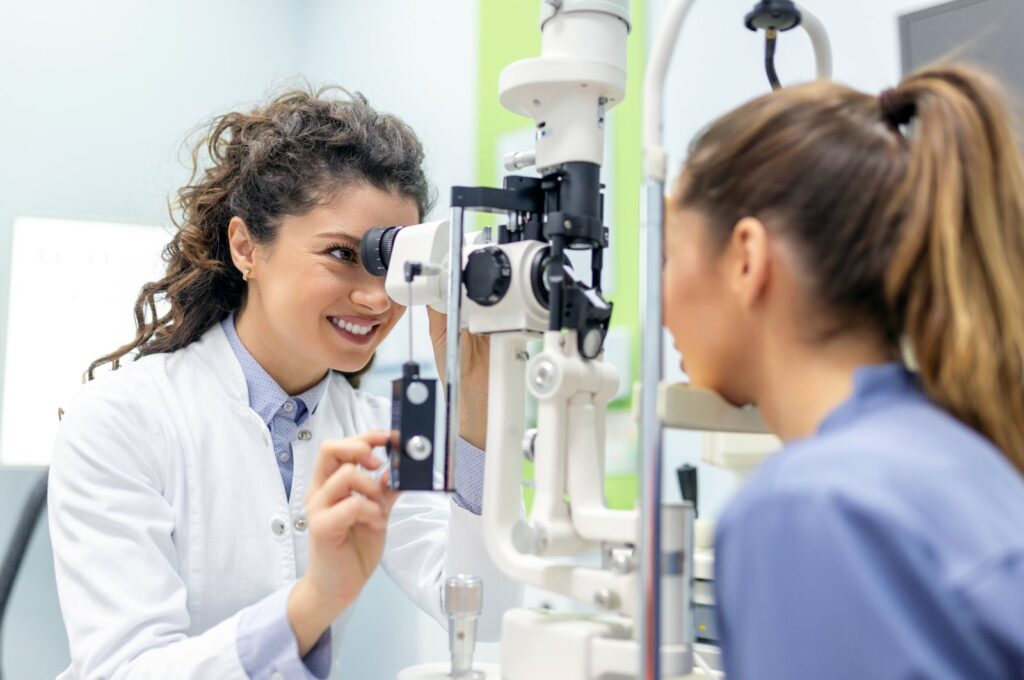
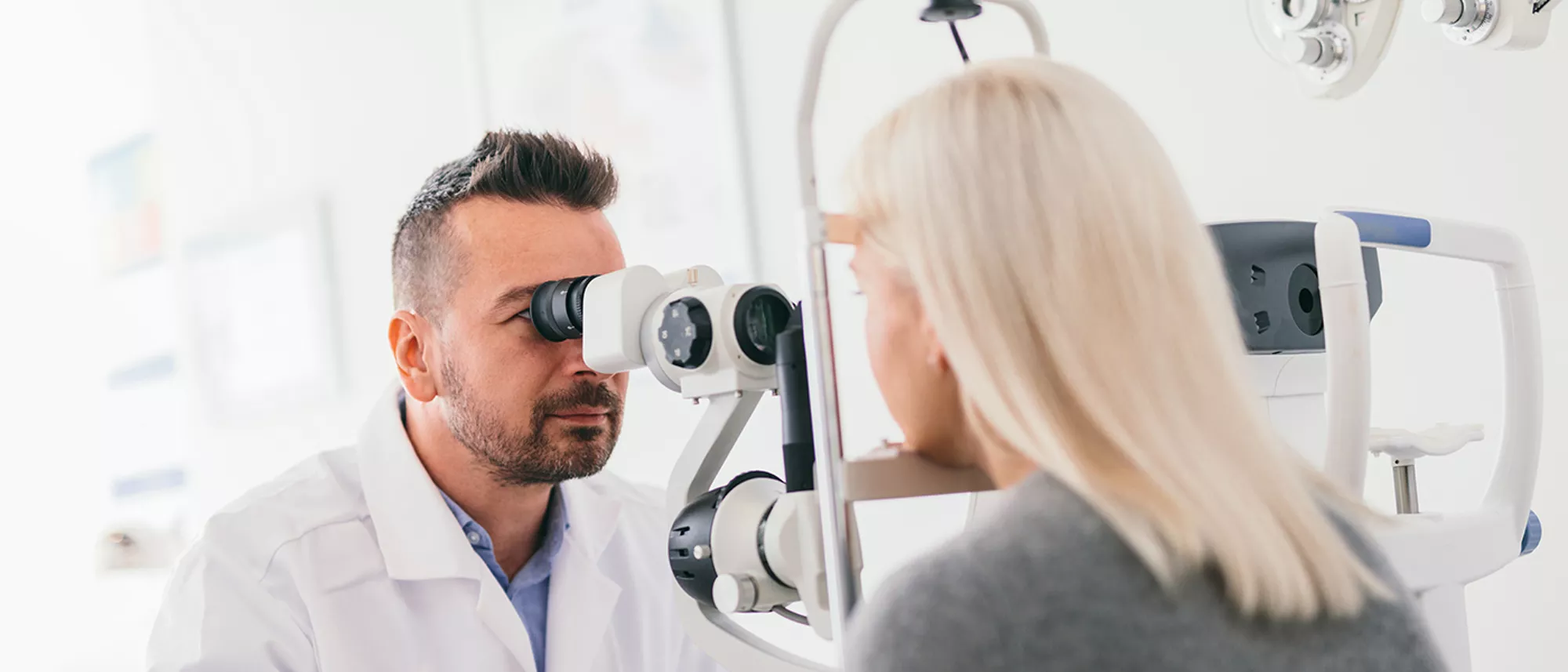
The examination also includes an internal and external eye-health assessment. The College states that this normally includes examining the eyes internally and externally, using direct ophthalmoscopy as a minimum internal method, and using slit-lamp biomicroscopy where a more detailed front-of-eye view is needed. This is where the optometrist is looking for signs of disease, not just blur.
Extra tests may be added if your clinical risk justifies them
If your symptoms, age, history, or risk profile suggest it, the optometrist may also assess ocular muscle balance, pupil reflexes, objective refraction, fundal or other imaging, intraocular pressure, and visual fields, especially for patients at risk of glaucoma. This is one reason you should not compare your appointment too closely with someone else’s. A more detailed test does not automatically mean something is wrong; often it just means the clinician is being appropriately cautious.
In many cases, the whole appointment is relatively straightforward. RNIB says an eye examination with an optometrist will probably last somewhere between 20 and 45 minutes, although this can vary if extra checks are needed.
What patients often do not realise the optometrist is assessing
One of the biggest misconceptions is that the test ends once the optometrist knows whether you are short-sighted or long-sighted. In reality, the appointment also helps answer practical questions: Are your symptoms linked to driving demands? Is your focusing system coping with screen work? Are your eye muscles working together properly? Is there a pattern that points to glaucoma risk rather than ordinary refractive error?
That broader perspective matters because some serious eye conditions can develop quietly. RNIB notes that optometrists can spot early signs of eye problems and even general health conditions such as high blood pressure and diabetes, where earlier detection often leads to better outcomes. An NHS eye examination is therefore one of the few high-street appointments that can pick up both optical and medical issues before they become harder to manage.
What happens after the test
After the examination, the optometrist should explain the results. In many cases, the outcome is simple: your prescription is unchanged, or you need new glasses or contact lenses. In other cases, the clinician may recommend closer monitoring, an earlier re-test, or onward referral. RNIB says the optometrist should discuss the results with you, and official UK guidance also makes clear that patients can be referred to a doctor or hospital ophthalmologist if the problem needs investigation or treatment.
This is also where expectations matter. An NHS eye examination is a gateway, not the end of the pathway. If the optometrist finds evidence of cataract, glaucoma suspicion, retinal disease, or another concern, the next step may be referral into specialist eye care rather than an immediate in-practice solution.

Who gets a free NHS eye test in England, and what costs may still remain?
In England, an NHS sight test is free only if you are in an eligible group and the test is clinically necessary. The live NHS guidance says eligibility includes, among others:
- children under 16, and 16 to 18-year-olds in full-time education
- adults aged 60 or over
- people registered as sight impaired or severely sight impaired
- people diagnosed with diabetes or glaucoma, or at risk of glaucoma
- people aged 40 or over with a parent, sibling, or child diagnosed with glaucoma
- some people receiving qualifying benefits or holding HC2 support, with some HC3 help available in certain cases
Those rules are more generous than many people assume, but they do not cover everyone.
Even if your test is NHS-funded, glasses and contact lenses are not automatically free. In England, the NHS uses optical vouchers to contribute towards the cost if you qualify. The NHS says voucher values currently range from £42.40 to £233.56, depending on the prescription, and DHSC guidance says the England optical voucher values remained unchanged from 1 April 2025. That means some patients will still pay the difference if they choose more expensive frames, coatings, or lens options.
There is another practical point many patients miss: if you are eligible for an NHS-funded test, the normal interval is every two years, but the NHS says you may have one earlier if your optometrist or ophthalmic practitioner considers that clinically necessary. So if your vision changes before the two-year mark, the answer is not to wait in silence it is to ask.
When a routine NHS eye examination is not the right appointment
A routine sight test is not the correct route for every eye problem. The NHS says you should go to A&E or call 999 if you suddenly cannot see from one or both eyes or if you have sudden severe eye pain. RNIB also flags sudden blur or distortion, loss of vision, eye injury, sudden flashes or floaters, and sudden pain as reasons to seek urgent assessment rather than waiting for a routine appointment. Depending on the area, that urgent care may be through hospital eye casualty or a local urgent eyecare service.
That distinction matters because patients often underplay eye symptoms. A gradual reading problem can usually wait for a routine booking. A curtain-like shadow, sudden distortion, or abrupt loss of vision should not.
Why regular NHS eye examinations matter even more in 2025 and 2026
The value of a community eye exam becomes clearer when you look at what is happening further down the pathway. A written parliamentary answer in March 2025 put the ophthalmology waiting list in England at 589,508, with only 66.8% of patients waiting 18 weeks or less. At the same time, the government’s 2025 vision profile showed over 9.8 million vision outpatient attendances in England in the financial year ending 2024. That combination tells a simple story: specialist eye care is busy, and catching problems earlier in the community matters more than ever.
This is also why policy is shifting toward stronger community eye-care pathways. In July 2025, the College of Optometrists highlighted the growing role of services such as community urgent eye care, pre- and post-cataract care, and glaucoma referral refinement. The College said 70% of people attending emergency departments for ocular problems could be managed in primary care, and where urgent community schemes are commissioned, 75% to 97% of acute eye cases can be fully managed there without onward referral. That is not just a system statistic; it is a sign that the high-street eye exam is becoming more clinically central, not less.
Conclusion
A modern NHS eye examination is a quiet but important piece of preventive medicine. Yes, it may end with a new prescription. But it can also flag glaucoma risk, spot retinal or cataract changes, identify symptoms that need referral and help route patients away from unnecessary delay. In England alone, the NHS relies on community optometry to deliver more than 13 million sight tests each year and that frontline role is becoming more valuable as demand on hospital eye services rises.
The smartest way to think about the appointment is this: it is not just a shopping step before buying glasses. It is one of the simplest ways to protect vision early, while the options for treatment and monitoring are still better. As UK eye care services continue moving toward more community based models in 2025 and 2026 patients who understand what to expect from an NHS eye examination will be in a stronger position to use the system well and act before a small visual change turns into a much bigger problem.
FAQs
What is an NHS eye examination?
An NHS eye examination is a sight test that checks your vision and the overall health of your eyes.
How long does an NHS eye test usually take?
Most appointments take around 20 to 45 minutes, depending on whether extra checks are needed.
Do NHS eye tests only check if I need glasses?
No. They can also help detect early signs of eye conditions such as glaucoma, cataracts, and retinal problems.
Who can get a free NHS eye test in England?
Free NHS eye tests are available for certain groups, including children, people over 60, some people with medical conditions, and those receiving qualifying benefits.
Do I need to bring anything to my appointment?
Yes. It helps to bring your current glasses, contact lens details, medication list, and proof of eligibility if needed.
Will I get my prescription after the test?
Yes. If you need glasses, the optometrist will give you your prescription after the examination.
Are glasses free after an NHS eye examination?
Not always. Some people qualify for NHS optical vouchers, but many patients still pay toward frames or lens upgrades.
Can an eye test detect other health problems?
Yes. In some cases, an eye test may show signs linked to conditions such as diabetes or high blood pressure.
How often can I have a free NHS eye test?
Many eligible people can have one every two years, although earlier tests may be allowed if clinically necessary.
When should I seek urgent help instead of booking a routine eye test?
You should seek urgent care if you suddenly lose vision, have severe eye pain, or notice sudden flashes, floaters or eye injury.