

A broken pair of glasses is rarely a small problem. For many people, it affects work, driving, reading, screen time and day-to-day independence within minutes. That matters because refractive errors remain the most common vision problem and the National Eye Institute says more than 150 million Americans have one. At the same time, the CDC says 93 million U.S. adults are at high risk for serious vision loss, yet only half visited an eye doctor in the previous 12 months. In other words, glasses are not a casual accessory for a large share of users; they are a daily necessity.
That is exactly why professional eyeglass repair has become more valuable in 2024–2026. The Vision Council’s Q1 2025 consumer data showed that 28% of eyeglass buyers spent $200 or more on their glasses, while broader market data for Q2 2025 showed the average value of a pair of frames was up by an estimated $21 versus 2024. When replacement costs are rising, repairing a good pair of glasses is no longer just a convenience decision. It is often the faster and financially smarter one.
Why broken glasses often cost more than people expect
Most people think of a broken frame as a simple hardware issue. In reality, the true cost of replacement usually includes more than the frame itself. If your prescription is outdated, chipped lenses need replacing or coatings must be re ordered the bill grows quickly. All About Vision notes that chipped or cracked lenses often need replacement rather than repair, and if your prescription is no longer current, that can mean scheduling another eye exam before new lenses are made.
There is also a timing cost. A replacement pair usually involves re-shopping, re-measuring, waiting for lenses, and adjusting the new fit. A professional repair, by contrast, often restores the pair you already know works. That means no adaptation period for frame fit, no risk of choosing the wrong bridge width or temple length and no disruption if you rely on progressives, occupational lenses or a favorite work pair.
Market conditions make this even more relevant. In April 2025, The Vision Council warned that plastic eyeglass frames imported from China were facing combined tariff rates of about 155%, alongside elevated duties on complete eyeglasses and related optical products. Even when retail effects vary by seller, that kind of supply chain pressure makes repair look more attractive whenever your existing pair is still worth saving.
What professional eyeglass repair services actually fix
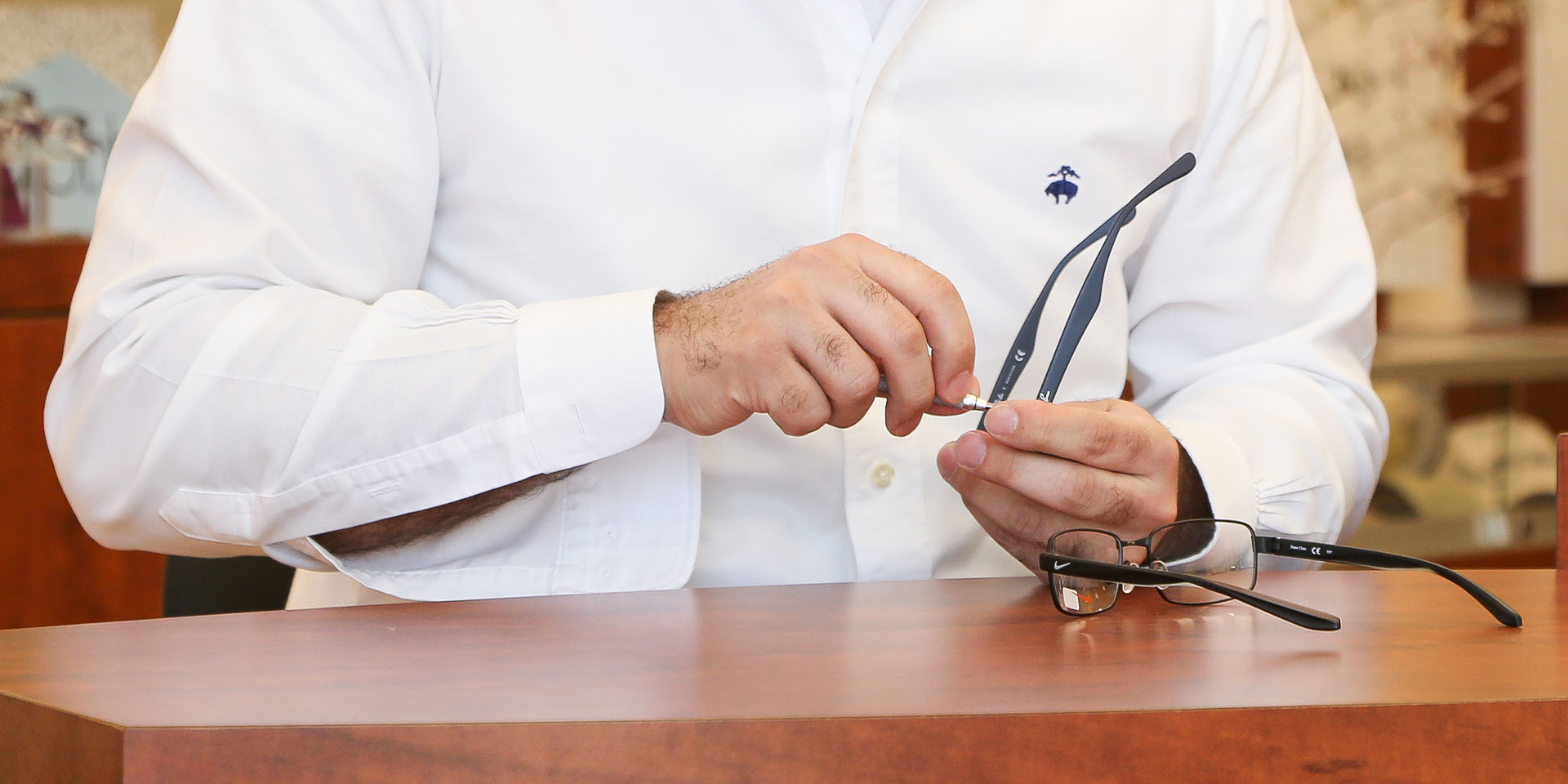
Professional eyeglass repair is much broader than tightening a loose screw. Specialized repair shops and optical service centers regularly handle structural, cosmetic, and fit-related issues that most consumers should not attempt at home. Current repair providers commonly advertise services for frame welding, temple replacement, hinge work, bridge repair, nose pad replacement, titanium laser welding, plastic frame fusion, and custom frame adjustments.
Common repairs that are usually worth professional attention
- Broken metal bridges, hinges, or temples that need welding or precision reassembly
- Cracked acetate or plastic frames that need controlled fusion rather than household glue
- Crooked frames that sit unevenly and affect comfort or lens position
- Nose pad, screw, rivet, and bushing issues that keep returning after quick fixes
- Rimless, drill-mount, titanium, or designer frames where a bad DIY repair can ruin the frame entirely
These are not cosmetic details. If glasses sit unevenly or the front is twisted, the lenses may no longer line up properly with your eyes. All About Vision specifically notes that imprecise frame repair can leave you looking through crooked glasses and affect visual performance, which is one reason professional alignment matters.
How professional repair saves you time
The biggest time advantage is simple: repair keeps a working system in service. If your prescription is still correct and your lenses are still in good condition, a repair shop can often restore the original pair instead of starting a full replacement cycle. That is especially useful for people who wear progressives, use specialized coatings, or have already spent time getting the fit exactly right.
Current service benchmarks show why this matters. World Optic’s published repair guide lists many common repairs, including metal welding, plastic fusion, titanium welding, and frame adjustments, with typical shop times of 24 to 48 hours, while lens-related jobs may take 24 to 72 hours. Some repair businesses also advertise same-day walk-in repairs for straightforward jobs, especially adjustments or localized frame fixes.
A real-world example makes the time case obvious. Imagine a professional who snaps a temple arm on Tuesday before a client meeting. Replacing the whole pair may mean browsing frames, waiting for lenses, and using an uncomfortable backup pair for days. A specialist repair service may solve the problem in a day or two, or even the same day for a local adjustment or hinge repair. In practical terms, that can save several hours of shopping and several days of compromised vision.
How professional repair saves you money
Repair saves money because it isolates the failed component instead of forcing a full reset. In many cases, the expensive part of a pair of glasses is not the screw or hinge that failed. It is the prescription lenses, coatings, custom fit, or brand-name frame. If those high-value parts are still good, replacing the entire pair is often financially inefficient.
Published repair pricing supports that logic. All About Vision says many places fix broken frames for under $50, while current pricing from World Optic lists common repairs such as metal frame welding at $45 to $55, plastic fusion at $45 to $99, broken screws at $12 to $49, and adjustments at $10 to $59. Those are not universal prices, but they are useful current benchmarks for the repair market.
The value becomes even clearer when you compare repair with current spending behavior. The Vision Council’s Q1 2025 data found that 28% of consumers spent $200 or more on eyeglasses. Preserving a good frame-lens combination with a targeted repair can therefore prevent a much larger out-of-pocket purchase.
The hidden money saver: stopping small problems before they become expensive ones
Small fit issues often become structural problems when they are ignored. A loose hinge puts extra stress on the temple. A missing nose pad changes how the frame sits and can increase bending pressure. A slightly twisted front can lead people to handle the glasses roughly every day, which speeds wear.
That is why routine professional adjustment is underrated. All About Vision notes that many eyewear outlets perform minor adjustments for free. Even when they do charge, the cost is usually far lower than replacing a frame that eventually snaps because a minor issue was left untreated.
DIY fixes have a place, but only for low-risk problems
DIY repair kits still make sense for very small issues. According to All About Vision, eyeglass repair kits typically cost about $3 to $20 and can help with basic screw tightening or simple nose pad replacement. For people who travel often, keeping one in a bag is a smart move.
But DIY is where many people accidentally turn a repairable problem into a replacement problem. Metal frames often require specialized welding equipment. Plastic frames can warp if heated unevenly. Strong glue can damage finishes, misalign joints, or make future professional repair harder. When a pair has prescription value, fit value, or brand value, expert handling is usually cheaper than trial-and-error at home.
When replacement is smarter than repair
Professional repair is not always the best answer. Sometimes replacement is the more rational choice.
Replacement usually makes more sense when:
- Lenses are chipped, cracked, or heavily scratched and need to be remade
- Your prescription has changed enough that keeping the old lenses no longer helps
- The frame has multiple past break points and the structure is fatigued
- Spare parts are discontinued and custom fabrication would cost too much
- Warranty replacement or insurance benefits reduce the price of a new pair enough to beat repair
This is where a good repair specialist earns trust: they should tell you when repair is not cost-effective. The best shops do not just “fix whatever arrives.” They help you decide whether the frame still deserves investment.
Repair also fits where the eyewear market is heading
There is a larger shift behind this topic. Consumers are paying more attention to durability, value, and sustainability. In 2024 optical market reporting covered by the Association of Optometrists, 43% of consumers said they would consider buying sustainable glasses or contact lenses. Repair fits directly into that mindset because it extends product life and reduces unnecessary replacement.
Policy trends support the same direction. The Council of the European Union says repair-focused rules entered into force in 2024 and are intended to make repair easier, cheaper, and faster. The EU links this push to 35 million tonnes of waste, 261 million tonnes of greenhouse gas emissions, and 30 million tonnes of resources used from still-usable goods being discarded. The U.S. EPA makes the same logic at a practical level: maintain and repair products so they do not need to be thrown out and replaced as often.
For optical businesses, this is more than an environmental talking point. Offering repair services can improve customer retention, create a service-based revenue stream, and differentiate a practice or store from low-commitment online sellers. In a market where price sensitivity is rising but consumers still want quality, repair is a strong trust signal.
How to choose a repair service that actually saves you money
Not every repair provider delivers the same value. The cheapest quote is not always the least expensive outcome if the work fails, parts do not match or alignment is poor.
Before handing over your glasses, ask:
- What exact repair method will be used for my frame material?
- Will you check frame alignment and fit after the structural repair?
- Is the repair warrantied?
- What is the realistic turnaround time not just the best case estimate?
- Are original or compatible parts available for this brand?
- If the repair fails inspection, will you tell me before charging for more work?
A professional who answers these clearly is usually more valuable than one who promises a quick fix without details.
Conclusion
Professional eyeglass repair services save time because they shorten the path back to clear, comfortable vision. They save money because they preserve the expensive parts of a pair you already own instead of forcing a full replacement. That matters even more in a market where eyeglass spending is rising, frame values have increased and optical supply costs have faced visible pressure.
The smartest takeaway is this if your prescription still works and the damage is localized, repair is often the better first option. It is not a last resort. It is asset preservation. Over the next few years as consumers keep looking for value, faster service and more sustainable choices, professional eyewear repair is likely to become less of a niche service and more of a standard part of smart eye care.
FAQs
What kinds of eyeglass damage can be repaired?
Loose screws, broken hinges, bent frames, missing nose pads and some cracked frames can often be repaired by professionals.
Is repairing glasses cheaper than buying new ones?
In many cases, yes. Repair usually costs much less than replacing prescription lenses and frames.
How fast can eyeglass repair be done?
Simple repairs may be done the same day, while more detailed repairs can take one to three days.
Can scratched lenses be repaired?
Light cleaning marks may improve with proper care but deep scratches usually require lens replacement.
Should I use glue to fix broken glasses at home?
It is better to avoid household glue because it can damage the frame and make professional repair harder.
Are metal frames easier to repair than plastic frames?
Metal frames are often easier to weld or reshape, while plastic frames may need more specialized repair methods.
Can expensive designer glasses be repaired?
Yes, many professional repair services handle designer and premium frames with specialized tools.
Do repair shops also adjust loose or crooked glasses?
Yes, most professional services can realign frames and improve the fit after repair.
When should I replace glasses instead of repairing them?
Replacement is usually better when lenses are badly damaged the prescription has changed, or the frame is beyond repair.
Why is professional repair better than DIY kits?
Professional repair is usually safer more accurate and more durable, especially for valuable prescription glasses.