
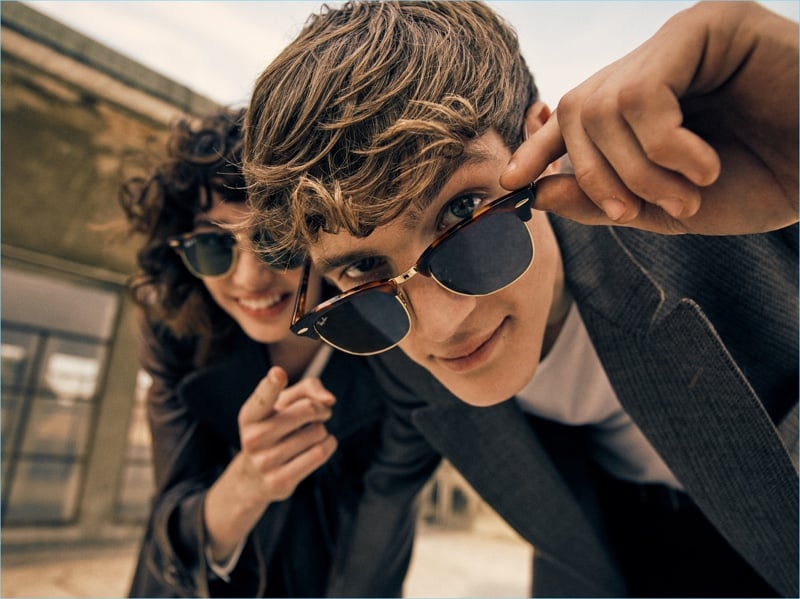
Ray-Ban still matters because modern eyewear is no longer just about seeing clearly or shielding your eyes from the sun. It now sits at the intersection of vision care, fashion, personal identity and increasingly, technology. That shift is happening inside a fast growing global eyewear market valued at about $200.46 billion in 2024, with forecasts pushing it to $221.89 billion in 2025 and $335.90 billion by 2030. At the same time, consumer need is not niche: The Vision Council reported in Q2 2025 that 82% of respondents use some form of vision correction and 69% of adults report having managed vision care coverage. In that environment, Ray Ban’s appeal is simple it offers frames people recognize instantly, while adapting to prescription needs, lens tech, customization and smart wearables.
Why Ray-Ban Still Defines Iconic Eyewear
A lot of brands become popular. Very few become visual shorthand for an entire category. Ray-Ban earned that status by building silhouettes that stayed relevant across decades instead of chasing every seasonal trend. On Ray-Ban’s official history pages, the Aviator dates to 1937, the Wayfarer to 1952, the Clubmaster Classic to 1986, and the Round Metal to 1989. The brand has also continued to evolve those designs with later reinterpretations like Wayfarer Reverse in 2023 and Mega Clubmaster in 2023. That balance of continuity and reinvention is a big reason the brand still feels familiar without feeling frozen in the past.
What makes this especially important is that style longevity has become a value issue, not just an aesthetic one. People buying eyewear today often expect one frame to work across workdays, commutes, travel, social occasions and sometimes prescription use. A design with proven staying power is easier to justify than a frame that looks dated after one season. Ray-Ban’s icons succeed because they are distinctive enough to be recognizable but restrained enough to keep wearing for years.
The Business Case for Ray-Ban’s Relevance in 2024–2026
Ray-Ban’s continued influence is not just cultural; it is backed by industrial scale and current momentum. EssilorLuxottica, Ray-Ban’s parent company, reported €26.5 billion in consolidated revenue in 2024, showing the kind of manufacturing, retail, and lens integration power that lets a brand stay visible globally rather than cyclically. In the company’s February 2025 full year results, EssilorLuxottica said Ray-Ban Meta had reached 2 million units sold since launch with strong acceleration in 2024. By the first half of 2025 the company was still highlighting Ray-Ban Meta and Ray-Ban prescription frames as key performance drivers, while Ray-Ban.com was described as a major engine of online growth.
That matters because the eyewear category is splitting into three strong demand lanes at once: medical utility, fashion identity and connected technology. Ray-Ban is one of the few names operating credibly in all three. Classic sun and optical frames still matter, but the brand has also become one of the clearest examples of how smart glasses can look mainstream rather than experimental. Reuters reported in January 2026 that Meta and EssilorLuxottica were considering doubling annual Ray-Ban smart-glasses output to 20 million units by the end of 2026, which signals how seriously the companies view future demand.
The Ray-Ban Styles That Keep the Brand Iconic
Ray-Ban’s strength is not that it offers endless random shapes. It is that a relatively tight group of styles covers very different personalities and use cases without losing the brand’s DNA. The official brand lineup still revolves around the Aviator, Wayfarer, Clubmaster and Round with newer expressions and material variations layered on top. Ray-Ban also explicitly positions the Clubmaster as a frame inspired by 1960s counterculture, which helps explain why it still reads as intellectual and slightly rebellious rather than merely retro.
Here is how those icons work in practice:
- Aviator suits people who want a lean, confident shape with strong visual presence but not too much bulk. It works especially well when you want a frame that feels sharp rather than trendy.
- Wayfarer is the safest all-rounder. It is casual enough for everyday wear, strong enough for streetwear styling, and adaptable enough for both sunglasses and prescription setups.
- Clubmaster is ideal for buyers who want personality without going loud. It usually reads more polished, more “editorial,” and more deliberate.
- Round tends to attract wearers who like softer geometry or want something with artistic character rather than corporate neutrality.
Those differences explain why Ray-Ban remains useful to shoppers the brand does not just sell fame; it sells recognizable style categories people can actually match to their wardrobe and face.
How to Choose Ray-Ban Eyewear Without Buying on Logo Alone
The smartest way to buy Ray-Ban is to start with fit and purpose, then narrow down by silhouette. Ray-Ban’s own digital tools reflect that logic. Its Frame Advisor Technology uses face scanning to assess face shape, size, and features, while the company also offers Virtual Try-On and a Size Advisor. That is a practical sign of where premium eyewear shopping is headed: less guesswork, more guided fit.
A better buying process looks like this:
- Choose the job first: everyday prescription wear, driving, travel, fashion rotation, or multi-use.
- Match frame weight to wear time: heavier acetate can look stronger; lighter titanium or thinner builds may feel better for long daily wear.
- Consider bridge fit early: if frames often slide, sit low, or press into cheeks, do not force a standard fit.
- Decide whether you need lens flexibility: prescription, polarized, Transitions, or clear everyday optics.
Ray-Ban also sells Low Bridge Fit options specifically for people whose eyewear tends to slide down the nose or sit too low, which is more than a comfort detail; it directly affects how good the frame looks on the face and how well prescription optics line up in daily use.
Even pricing shows why choosing by use case matters. On the Ray-Ban U.S. store, recent listed examples included the Clubmaster Classic at $191, New Wayfarer Classic at $231, and Ray-Ban Meta Wayfarer Gen 1 at $329. In other words, the jump from a classic frame to connected eyewear is real, but not so huge that it belongs to a separate luxury universe. For many buyers, the smarter question is not “What is cheapest?” but “Which version will I actually wear enough to justify the spend?”
Lens Strategy Is Where Style Becomes Performance
One of the biggest mistakes buyers make is treating the frame as the product and the lens as an add-on. In reality lens choice often determines whether a pair of Ray-Bans feels merely stylish or genuinely useful.
The American Academy of Ophthalmology is very clear on the non negotiable part: sunglasses should provide 100% UV protection, because UV exposure raises the risk of problems including cataracts, eye cancers, growths on the eye and sunburn on the eye. The AAO also notes an important distinction many shoppers miss: polarization reduces glare, but it does not replace UV protection.
Ray-Ban’s own lens offering reflects that more technical consumer mindset. Official product and lens pages highlight polarized options, prescription sunglasses, and Transitions lenses that adapt to changing light. Ray-Ban says its Transitions lens options are designed to be clear indoors and dark outdoors, and that they block 100% of UVA and UVB rays while also filtering blue-violet light on certain clear-lens configurations.
For buyers, the practical takeaway is straightforward:
- For driving and bright outdoor use, prioritize UV protection first, then add polarization for glare control.
- For one-pair convenience, photochromic or Transitions-style options are often more useful than owning multiple single-purpose pairs.
- For daily prescription wear, fit and lens alignment matter as much as the silhouette.
That is one reason Ray-Ban has stayed commercially strong: it sells recognizable frames, but it increasingly packages them with lens and optical logic that match modern buying behavior.
The Biggest Ray-Ban Trends to Watch from 2024 to 2026
1. Smart eyewear is no longer a side experiment
The strongest recent shift is that Ray-Ban is now central to mainstream smart glasses, not just traditional eyewear. The 2 million units sold milestone by early 2025, followed by continued H1 2025 momentum and 2026 production-expansion discussions, shows that connected eyewear has moved beyond novelty. For consumers, this makes Ray-Ban unusual: you can now buy into the brand for heritage style, prescription utility or wearable tech without leaving the same design ecosystem.
2. Personalization is becoming part of premium style
Ray-Ban’s Remix customization platform is another strong signal. On official pages, Ray Ban says Remix offers 37 styles, 149 lens types and 290 color options. That matters because premium eyewear buyers increasingly want recognizable design with personal variation not pure mass sameness. Customization lets Ray Ban preserve icon status while still offering individuality.
3. Materials and comfort are now style features
Ray-Ban’s newer direction also shows up in materials. Official bio-based pages say the company uses bio-based nylon lenses with at least 40% biological content from renewable sources like castor oil while some product pages specify 57% bio-based carbon content for non-metallic frames in certain models. Elsewhere, Ray-Ban continues to emphasize titanium for lightweight all day comfort. That shift is important because buyers increasingly expect premium to mean better materials and wearability, not just stronger branding.
Why Ray Ban Still Wins the Style Conversation
Ray-Ban’s real advantage is not that it is old, famous, or expensive. It is that the brand has managed to stay culturally legible while upgrading what eyewear needs to do. It still owns some of the most recognizable frame shapes in the market, but it has also adapted to how people shop now: they want fit tools, prescription compatibility, lens options, lower-friction customization and in some cases, smart features built into a frame they would actually choose to wear.
Conclusion
Exploring iconic style through Ray Ban eyewear is really about understanding why some brands survive every fashion cycle while others fade. Ray-Ban has held its place because it built enduring shapes, kept them commercially relevant and updated them for the realities of modern eyewear: more prescription demand more lens sophistication more personalization and a genuine move into connected wearables. In 2024–2026 that combination looks even more powerful. The future of eyewear is not just stylish or functional it is hybrid. Ray-Ban remains iconic because it has learned how to be both.
FAQs
Why is Ray-Ban considered an iconic eyewear brand?
Ray Ban is known for timeless frame styles like Aviator, Wayfarer, Clubmaster and Round that have stayed popular for decades.
Which Ray-Ban style is best for everyday wear?
The Wayfarer is often the best everyday option because it works well with casual, smart and semi-formal looks.
Are Ray-Ban glasses only for fashion?
No, Ray Ban eyewear combines style with practical features like prescription lenses, UV protection and polarized options.
What should I check before buying Ray Ban eyewear?
Focus on face shape, frame size, bridge fit, comfort and the type of lenses you need.
Do Ray-Ban sunglasses provide UV protection?
Yes, many Ray-Ban sunglasses are designed to offer 100% UV protection, which is essential for eye safety.
What is the difference between polarized and UV protective lenses?
UV protection shields your eyes from harmful rays while polarized lenses reduce glare from surfaces like roads and water.
Are Ray Ban glasses available with prescription lenses?
Yes, Ray Ban offers many optical and sun styles with prescription lens options.
What is Ray-Ban Meta eyewear?
Ray Ban Meta is the brand’s smart eyewear line that combines classic Ray-Ban design with connected technology features.
Can I customize my Ray-Ban glasses?
Yes, Ray Ban offers customization options for certain styles, including frame colors and lens choices.
Why does Ray-Ban remain popular in 2024–2026?
Ray-Ban stays relevant by combining classic design new lens technology, customization and smart eyewear innovation.